Can a Machine Think?
Alan Turing published the paper that reframed the oldest question in AI and gave the field its most famous test.
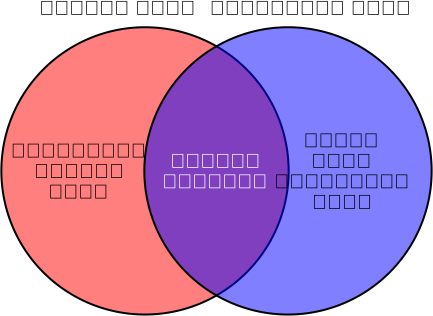
Assamese translation by দিব্য দত্ত / CC BY-SA 4.0
I propose to consider the question, 'Can machines think?'
— Alan Turing
Can a Machine Think? (1950)
In 1950, Alan Turing published “Computing Machinery and Intelligence,” a groundbreaking paper that introduced the concept of the Turing test, challenging the notion of whether machines could think.
What happened: In his 1950 paper, Alan Turing addressed the question “Can machines think?” by proposing a practical test, now known as the Turing test, which involves a human evaluator assessing natural language conversations between a human and a machine to determine if the machine can exhibit intelligent behavior equivalent to, or indistinguishable from, that of a human. Computing Machinery and Intelligence
Why it matters: Turing’s paper not only provided a concrete method for evaluating machine intelligence but also anticipated and rebutted many of the objections to artificial intelligence that would arise in the decades to follow. This work laid the foundation for the field of AI, setting a standard for what it means for a machine to be intelligent and influencing the direction of research and development in the area.
Further reading:
Why This Mattered
Turing's 1950 paper 'Computing Machinery and Intelligence' replaced the vague question 'Can machines think?' with a concrete operational test — the Imitation Game — giving researchers a measurable target. The paper anticipated and rebutted nearly every major objection to machine intelligence decades before they became mainstream debates, and its influence shaped the goals and rhetoric of the entire field.