The Million-Dollar Algorithm Contest
Netflix offered a million dollars to anyone who could improve its recommendation engine by 10%, igniting a global competition that transformed machine learning.
Ivongala / Public domain
We're quite curious, really. We want to find out if someone knows something about predicting how much someone is going to love a movie based on their movie preferences.
— Reed Hastings
In 2006, Netflix launched a groundbreaking competition offering a million dollars to anyone who could improve their movie recommendation algorithm by 10%. This challenge, known as the Netflix Prize, involved predicting user ratings for films based solely on previous ratings, without any additional user or movie information.
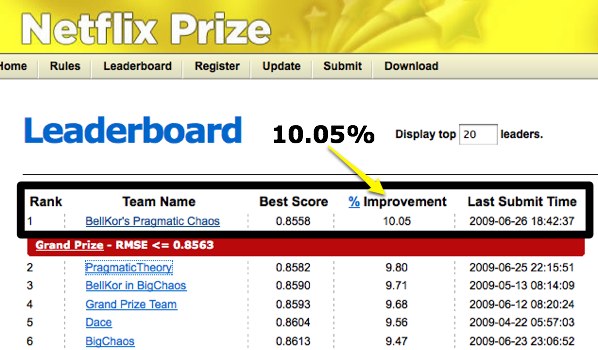
What happened: In 2006, Netflix CEO Reed Hastings and his team, including James Bennett, announced the Netflix Prize, a competition aimed at improving the company’s movie recommendation algorithm. The contest was open to anyone outside of Netflix’s internal network and certain restricted countries. After three years of intense competition, the BellKor’s Pragmatic Chaos team, which included members from AT&T Labs, won the grand prize of $1,000,000 by surpassing Netflix’s own algorithm by 10.06%. Netflix Prize
Why it matters: The Netflix Prize was a pivotal moment in the history of machine learning, demonstrating the power of ensemble methods in predictive modeling. The competition also highlighted the value of public data science competitions, directly inspiring platforms like Kaggle. This event reshaped how practitioners approached predictive modeling and underscored the importance of collaborative problem-solving in the field of artificial intelligence. BellKor’s Pragmatic Chaos
Further reading:
Why This Mattered
The Netflix Prize became one of the most famous open competitions in machine learning history. It demonstrated that ensemble methods—combining many models—could dramatically outperform any single algorithm, a lesson that reshaped how practitioners approached predictive modeling. The contest also popularized the idea of public data science competitions, directly inspiring platforms like Kaggle.