The Machine That Learned by Dreaming
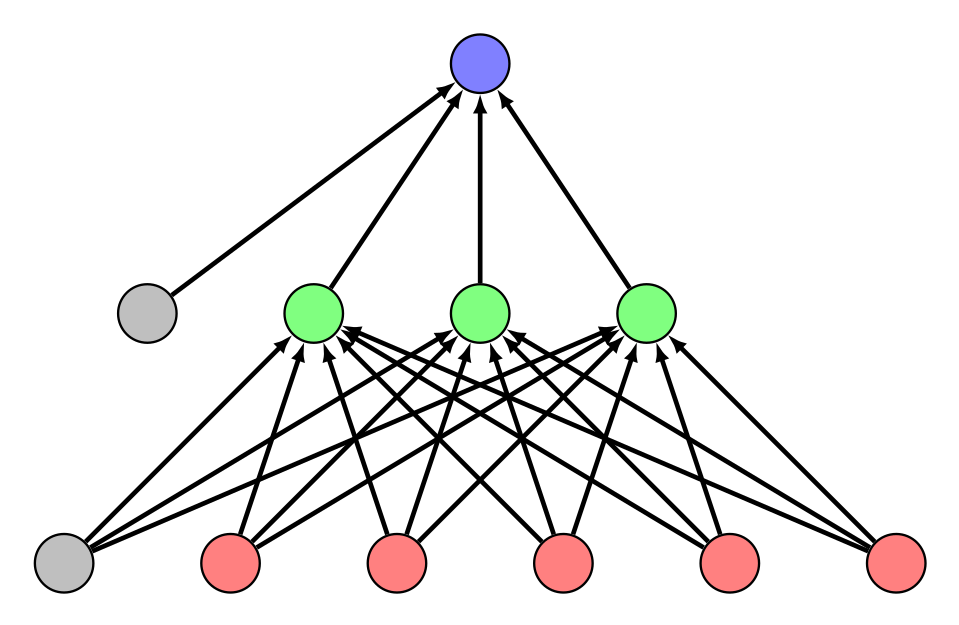
Hinton and Sejnowski invented the Boltzmann machine, a neural network that learned by simulating the random thermal fluctuations of molecules.
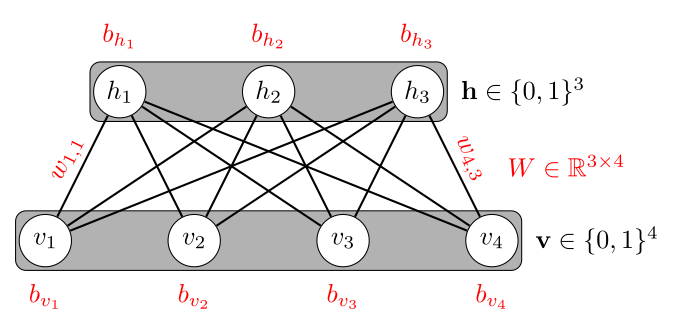
MartinThoma / CC0
The Boltzmann machine learning algorithm is the first example of a learning algorithm that can discover features that are not explicit in the input.
— Geoffrey Hinton
In 1985, Geoffrey Hinton and Terry Sejnowski introduced the Boltzmann machine, a groundbreaking neural network that paved the way for modern deep learning techniques.
What happened: In 1985, Geoffrey Hinton and Terry Sejnowski published a paper introducing the Boltzmann machine, a type of neural network that uses principles from statistical physics to learn from data. The Boltzmann machine is a stochastic Ising model that is theoretically intriguing due to its locality and Hebbian nature of training, and its resemblance to simple physical processes. A Learning Algorithm for Boltzmann Machines - Cognitive Science, 1985
Why it matters: The Boltzmann machine’s introduction of stochastic methods and generative modeling concepts laid the foundation for later developments such as deep belief networks and variational autoencoders. These advancements have been crucial in driving the deep learning renaissance, enabling more sophisticated and effective machine learning models. The Boltzmann machine’s impact extends beyond theoretical interest, as it has practical applications in machine learning and inference when properly constrained.
Further reading:
Why This Mattered
The Boltzmann machine was the first neural network to use a principled learning algorithm for hidden units, drawing on ideas from statistical physics. It introduced stochastic methods and generative modeling concepts that would later prove foundational for deep belief networks, variational autoencoders, and the entire deep learning renaissance.